
NORR
NORR Secures Living Future’s Zero Carbon Certification™ Ready Designation for Its Own Toronto Office using Qflow Data

NORR Secures Living Future’s Zero Carbon Certification™ Ready Designation for Its Own Toronto Office
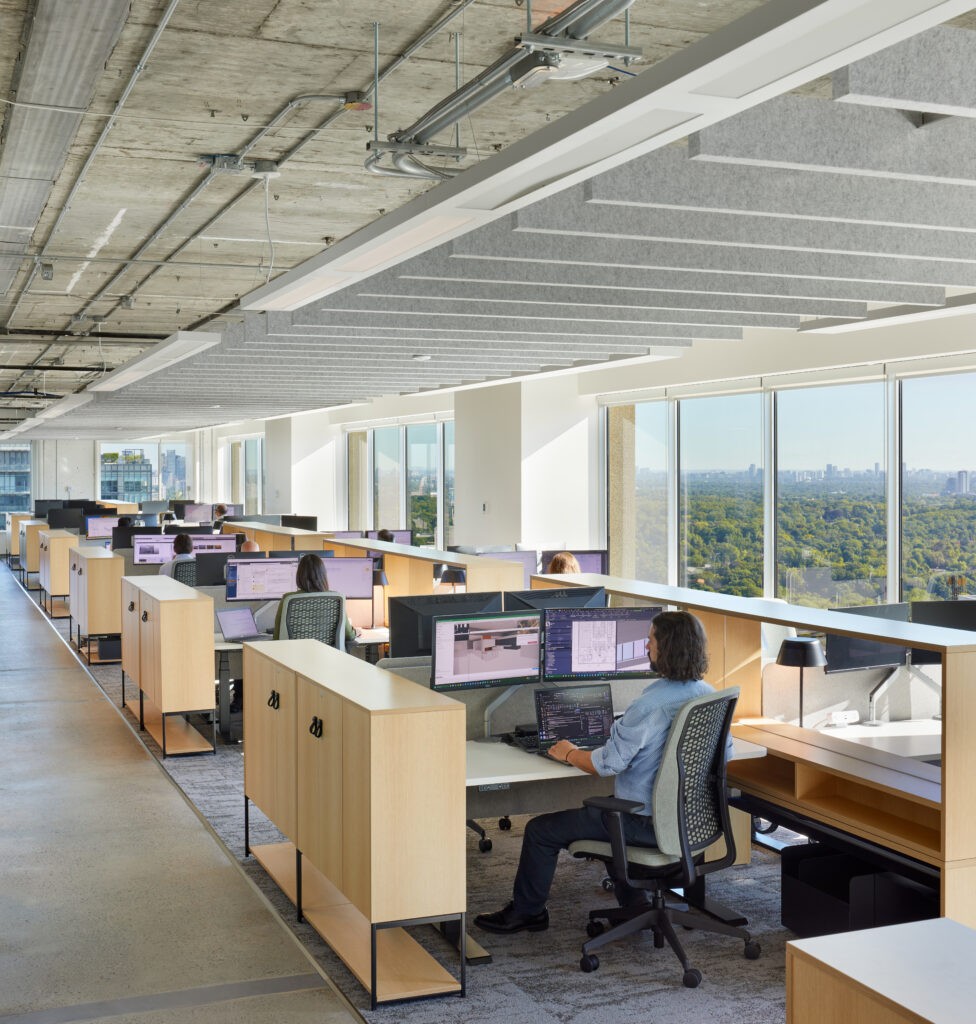
NORR, a global architecture and engineering firm with offices across the US, UK, and Canada, relocated its largest office to 2 Bloor Street East in downtown Toronto. The firm used the project to demonstrate its commitment to sustainable design and construction, showing how straightforward it can be to meet and exceed the same sustainability standards it recommends to clients. This included pursuing Living Future’s Zero Carbon Certification™, which requires many measures, including full disclosure of embodied carbon across a project’s lifecycle, not only at the design stage, but throughout construction and across a project’s operations.
About Living Future’s Zero Carbon Certification™
The Living Future’s Zero Carbon Certification™ is one of the industry’s most rigorous standards for verifying a building’s actual total operational and embodied carbon performance. Unlike certifications focused primarily on design intent, it additionally requires project teams to demonstrate how carbon was managed in construction and in ongoing operations using documented, verifiable data.
This includes accounting for embodied carbon during construction, particularly A4 material transportation, A5 construction activities, and waste, which can be among the most challenging life cycle stages to evidence accurately.
The Challenge
This project presented NORR with an opportunity to align its practice-based sustainability commitments (AIA2030, MEP2040, SE2050, and A&D Materials Pledge) to its commitment to achieve net zero emissions by 2050. The Zero Carbon Certification™ standard was chosen, given its focus on carbon accountability, as well as for its alignment with these goals, as well as the speed and budget of a fast turnaround fit out project.
That meant producing a complete record of design and construction-phase emissions while keeping pace with an active project. While the design side was managed by the project delivery team, the construction side required information to be generated daily by suppliers, subcontractors, and waste haulers, making it difficult to collect, organize, and verify through traditional manual processes.
NORR needed a practical way to capture this information throughout construction and present it in a format suitable for certification review and within the stringent allowances of the rating system.
Why Qflow?
NORR needed a way to capture transportation, construction site activity, and waste hauling data, in real-time, rather than reconstruct it after the fact from paperwork scattered across the project team. Qflow gave NORR’s sustainability team, and their contracting partner – Allyant, a running record of exactly that: material movements, onsite activity, and waste hauling data logged at the source throughout construction – and all with the associated GHG emissions quantified.
This ensured both a smooth Living Future’s submission at the end of construction, as well as meant the team could track and monitor progress in real-time to ensure the project was under budget for as-built embodied emissions throughout. Such a strategy, they felt, could be applied to any project moving forward, to support the construction industry’s shift towards supporting low-carbon design, whether projects are pursuing third-party certifications, or not. This is increasingly important, as more mainstream standards – like LEEDv5, and others – are recognizing the importance of tracking A4-5 lifecycle emissions of projects. Note: the A4-A5 emissions of this project represented ~15% of the total embodied emissions of the entire project.
How They Use Qflow
For the Toronto office, Qflow gave NORR’s sustainability team one structured source of truth for all embodied carbon data across the site and supply chain ecoystem:
- Transport tracking A4: measures the life-cycle carbon footprint of transporting building materials from the factory gate to the construction site. Zero Carbon Certification™ requires project teams to document verified shipment distances, transport modes, and total freight weights, ensuring all material’s actual embodied emissions are accounted for and offset at Substantial Completion. When material deliveries are captured at the source, an accurate A4 record is built instantly, creating a reliable evidence trail without the need to reconstruct the data later, manually.
- Site activity documentation: Onsite construction activity is captured continuously, giving the team a running A5 record rather than relying on slow, data-lacking invoices.
- Waste hauling records: Waste hauling data is tracked and tied to disposal and diversion outcomes, supporting certification reporting alongside broader compliance needs.
- EC3 Integration for reporting: Qflow’s structured carbon data was prepared for use in EC3, supporting reporting requirements for this, and many other rating systems, while eliminating manual data entry and maintaining a clear, traceable record of project emissions mapped to EPD’s
“The Qflow tracking and reporting outputs were very helpful in documenting transport, site activity, and waste hauling emissions in a clear and audit-ready format. This has been a successful collaboration, and we appreciate the team’s responsiveness and technical support.”
The Results: A4 and A5 Documentation Accepted by ILFI
A4 and A5 emissions documentation, built on Qflow data, accepted by the Living Future’s review as part of the Zero Carbon Certification™ Ready designation for NORR’s Toronto office.
That acceptance cleared one of the more technically demanding hurdles in the overall certification process, as well as broke new ground in terms of integration of AI to fill this major industry gap, without major disruption or investment. It’s the point where many carbon-neutral project pursuits stall, or miss completely, on exactly the kind of construction phase data Qflow was handily able to capture throughout the design and construction process.
Scaling the Success
The opportunity extends far beyond certification. The Toronto office demonstrated a repeatable way to bring construction-phase carbon data into everyday project delivery, whether or not a project is pursuing a third-party sustainability standard.
By combining NORR’s sustainability expertise with Qflow’s automated construction data capture, contractors can build a reliable record of materials, transportation, site activity, and waste through existing site workflows, without creating another reporting burden for project teams.This gives contractors a practical way to become more proactive partners to architects, engineers, and clients: providing the evidence needed to understand construction-phase emissions, make more informed decisions, and ultimately deliver better, more accountable projects.
For projects pursuing certification, that same dataset can support reporting requirements. For the much larger number that are not, it provides a straightforward way to bring greater carbon accountability into business-as-usual construction.
Speak with our expert sales team to book a demo
Enabling responsible, resource efficient construction; cutting waste and carbon. Qflow automates on site data capture and auditing, feeding it into your existing tools
